> For the complete documentation index, see [llms.txt](https://docs.ngsurvey.com/llms.txt). Markdown versions of documentation pages are available by appending `.md` to page URLs; this page is available as [Markdown](https://docs.ngsurvey.com/ar/conversational-surveys/rsalh-qalb-unifonic.md).
# رسالة قالب Unifonic
إذا كنت تستخدم Unifonic كمزوّد WhatsApp الخاص بك فستحتاج إلى ضبط رسالة القالب باستخدام محتوى الجسم التالي:
المحتوى عبارة عن تكوين قائم على JSON يتيح لك تحديد اسم رسالة القالب التي تود استخدامها للتفاعل الأول والتي قمت بتعريفها في حساب Unifonic الخاص بك، ورمز اللغة، وإذا كنت قد عرّفت أي عناصر نائب فيمكنك إضافة قيم عناصر نائب اختيارية.
بشكل افتراضي، يتوقع ngSurvey الردود التالية عند التفاعل الأول مع المستجيب الذي تلقى رسالة القالب
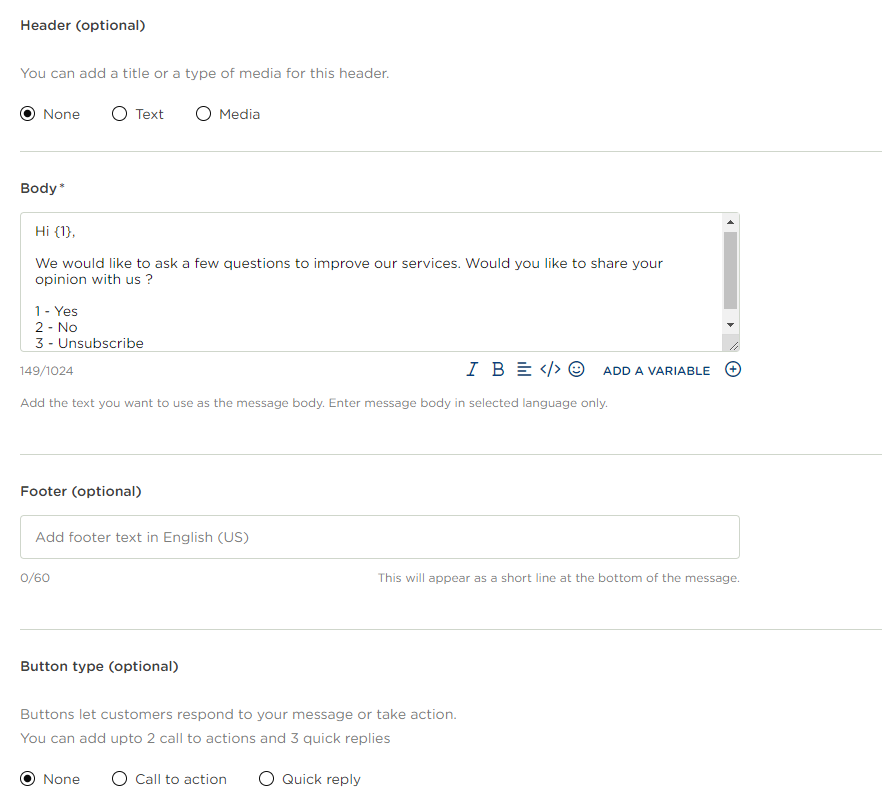
1 - المشاركة في الاستبيان\
2 - عدم المشاركة في الاستبيان\
3 - إلغاء الاشتراك
لذلك نوصي بتكوين رسالة قالب في حساب Unifonic تكون على النحو التالي:
{% hint style="info" %}
إذا كنت تستخدم لوحات (panels) لإرسال دعوة WhatsApp، فمن الممكن توصيل قيم سمات أعضاء اللوحة إلى عنصر النائب ديناميكيًا باستخدام تنسيق ++panelistattributename++.
{% endhint %}
---
# Agent Instructions
This documentation is published with GitBook. GitBook is the documentation platform designed so that both humans and AI agents can read, navigate, and reason over technical content effectively. Learn more at gitbook.com.
## Querying This Documentation
If you need additional information that is not directly available in this page, you can query the documentation by asking a question.
Perform an HTTP GET request on the following URL with the `ask` and `goal` query parameters:
```
GET https://docs.ngsurvey.com/ar/conversational-surveys/rsalh-qalb-unifonic.md?ask=&goal=
```
`ask` is the immediate question: it should be specific, self-contained, and written in natural language.
`goal` is what the user is ultimately trying to achieve, the reason they need the answer. Sharing it helps GitBook give you a better, more relevant answer. A goal is most helpful when it describes the outcome the user wants rather than restating the question. For example, with `ask=how do I create an API token`, a goal like `automate deployments from our CI pipeline` lets GitBook tailor the answer to that use case.
The response will contain a direct answer to the question and relevant excerpts and sources from the documentation.
Use this mechanism when the answer is not explicitly present in the current page, you need clarification or additional context, or you want to retrieve related documentation sections.