> For the complete documentation index, see [llms.txt](https://docs.ngsurvey.com/llms.txt). Markdown versions of documentation pages are available by appending `.md` to page URLs; this page is available as [Markdown](https://docs.ngsurvey.com/de/installation-setup/system-settings/mobiles-messaging/iis-smtp-exchange-server.md).
# HTTP-SMS-Messaging
Ermöglicht ngSurvey die Nutzung beliebiger HTTP-fähiger SMS-Dienstleister.
## 🔅 HTTP-Eigenschaften
* **`HTTP-Endpunkt-URL`**ist der Endpunkt Ihres Anbieters, der aufgerufen wird, wenn ngSurvey eine SMS senden muss. Sie können folgende Tags verwenden, die bei Bedarf dynamisch in Ihrer URL ersetzt werden: {{to}} und {{message}}
* **`HTTP-Header 1`**wird als Teil der Anfrage an den Endpunkt gesendet.
* **`HTTP-Header 2`**wird als Teil der Anfrage an den Endpunkt gesendet.
* **`JWT-Token`**wenn angegeben, versucht ngSurvey eine auf "Bearer" basierende Authentifizierung.
* **`HTTP-Body`**ist der Body, der an den Endpunkt gesendet wird, falls der Endpunkt einen POST erfordert.
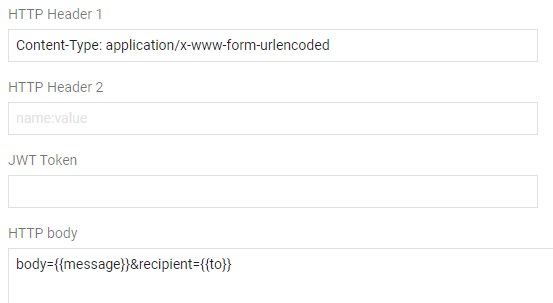
Wenn Ihr Anbieter für den POST einen urlencoded-Content-Type verlangt, können Sie die Einstellungen beispielsweise wie folgt verwenden und angeben:
---
# Agent Instructions
This documentation is published with GitBook. GitBook is the documentation platform designed so that both humans and AI agents can read, navigate, and reason over technical content effectively. Learn more at gitbook.com.
## Querying This Documentation
If you need additional information that is not directly available in this page, you can query the documentation by asking a question.
Perform an HTTP GET request on the following URL with the `ask` and `goal` query parameters:
```
GET https://docs.ngsurvey.com/de/installation-setup/system-settings/mobiles-messaging/iis-smtp-exchange-server.md?ask=&goal=
```
`ask` is the immediate question: it should be specific, self-contained, and written in natural language.
`goal` is what the user is ultimately trying to achieve, the reason they need the answer. Sharing it helps GitBook give you a better, more relevant answer. A goal is most helpful when it describes the outcome the user wants rather than restating the question. For example, with `ask=how do I create an API token`, a goal like `automate deployments from our CI pipeline` lets GitBook tailor the answer to that use case.
The response will contain a direct answer to the question and relevant excerpts and sources from the documentation.
Use this mechanism when the answer is not explicitly present in the current page, you need clarification or additional context, or you want to retrieve related documentation sections.